“Our anxiety does not come from thinking about the future, but from wanting to control it.”
— Kahlil Gibran
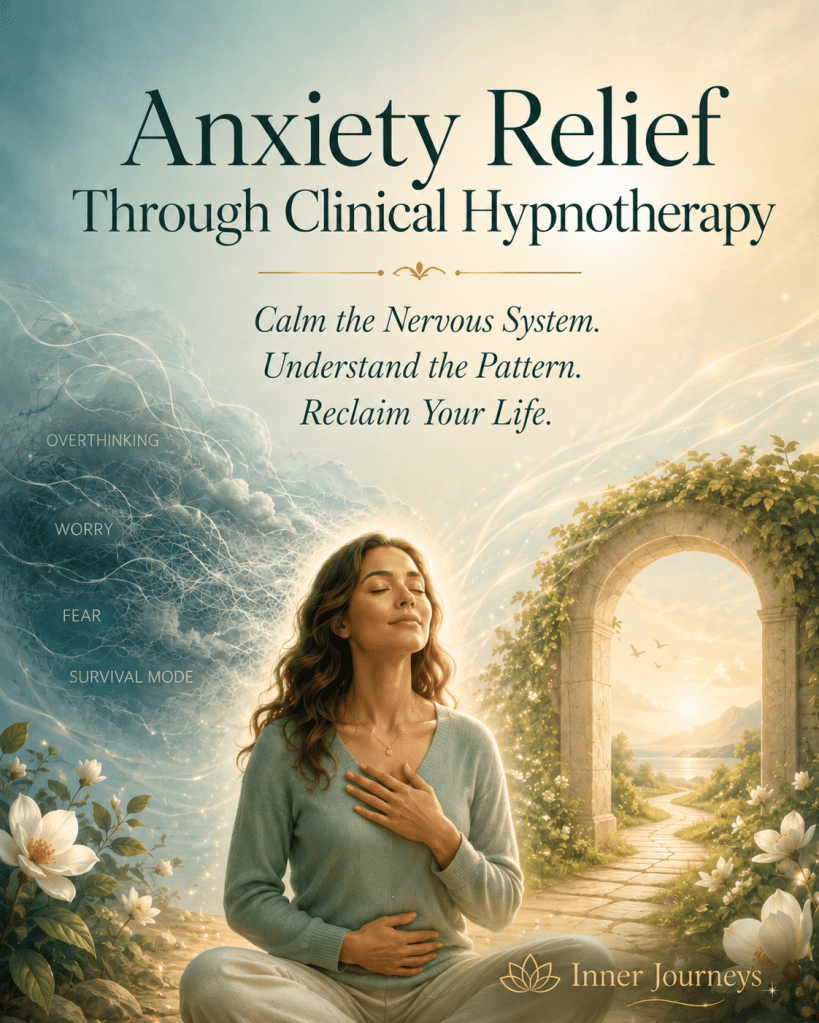
Calm the Nervous System. Understand the Pattern. Reclaim Your Life.
You may appear calm and capable on the outside, while your mind remains constantly alert on the inside.
You may repeatedly anticipate what could go wrong, replay conversations, worry about your health or relationships, struggle to sleep, or find it difficult to relax even when there is no immediate danger.
You may understand logically that your fears are excessive, yet still feel unable to stop them.
Anxiety is not always a failure of logic or willpower. Often, it is a protective response that has remained switched on for too long.
At Inner Journeys: Within & Beyond®, we use Clinical Hypnotherapy within an integrative, trauma-informed and regulation-first framework to help you calm the mind and body, understand the patterns sustaining anxiety, and develop greater emotional safety and self-regulation.
🌿 Begin Your Anxiety Healing Journey
Are You Living in a Constant State of Alert?
Anxiety can affect the way you think, feel, behave and experience your body.
You may recognise some of these patterns:
• Persistent worry that is difficult to control
• Repeatedly imagining worst-case scenarios
• Overthinking decisions and conversations
• Feeling restless, tense, irritable or emotionally overwhelmed
• Heart palpitations, sweating, trembling or breathlessness
• Tightness in the chest, jaw, neck, shoulders or stomach
• Difficulty falling asleep or waking with anxious thoughts
• Fear of losing control, becoming unwell or making a mistake
• Avoiding people, places or situations that feel threatening
• Seeking repeated reassurance from others
• Perfectionism, overplanning or excessive preparation
• Difficulty concentrating or remaining present
• Feeling exhausted from being constantly vigilant
For some people, anxiety appears suddenly after a stressful event. For others, it develops gradually through years of pressure, emotional insecurity, trauma, unresolved fear or an excessive need to remain in control.
Anxiety Is Not Just Overthinking
Telling an anxious person to “stop thinking” rarely works.
The conscious mind may know that there is no immediate danger, while the subconscious mind and nervous system continue to respond as though a threat is present.
The anxiety cycle may involve:
- A situation, thought, sensation or memory is interpreted as threatening.
- The body activates a protective response.
- Physical sensations such as a racing heart, tight chest or dizziness are noticed.
- These sensations are interpreted as further evidence that something is wrong.
- Worry, avoidance and reassurance-seeking temporarily reduce discomfort.
- The nervous system learns that the situation must truly have been dangerous.
Over time, this cycle can become automatic.
This is why anxiety may continue even when you understand it intellectually. The response is not being generated by conscious thought alone.
Why Does Anxiety Keep Returning?
There is rarely one single cause.
Anxiety may be sustained by a combination of:
Chronic Stress: Long periods of pressure, overwork, caregiving, conflict or uncertainty can keep the mind and body in a state of readiness.
Unresolved Emotional Experiences: Past rejection, humiliation, instability, loss, neglect or trauma may sensitise the nervous system to present-day situations.
Childhood Conditioning: Growing up around criticism, unpredictability, conflict, emotional neglect or excessive expectations can teach a child to remain constantly watchful.
Perfectionism and Fear of Failure: When mistakes feel unsafe, the mind may attempt to control every possible outcome through preparation, overthinking and self-criticism.
Avoidance: Avoiding anxiety-provoking situations brings short-term relief but can strengthen the belief that the situation is dangerous or unmanageable.
Internal Conflict: One part of you may want change, visibility, intimacy or success, while another part fears exposure, rejection, failure or loss of control.
Physical and Lifestyle Factors: Poor sleep, chronic stress, excessive caffeine, substance use, medication effects and some medical conditions may contribute to anxiety symptoms.
Effective healing requires understanding your individual anxiety pattern, rather than applying one standard technique to everyone.
How Clinical Hypnotherapy May Help
Hypnosis is a natural state of focused attention in which the mind becomes calmer and more receptive to therapeutic learning.
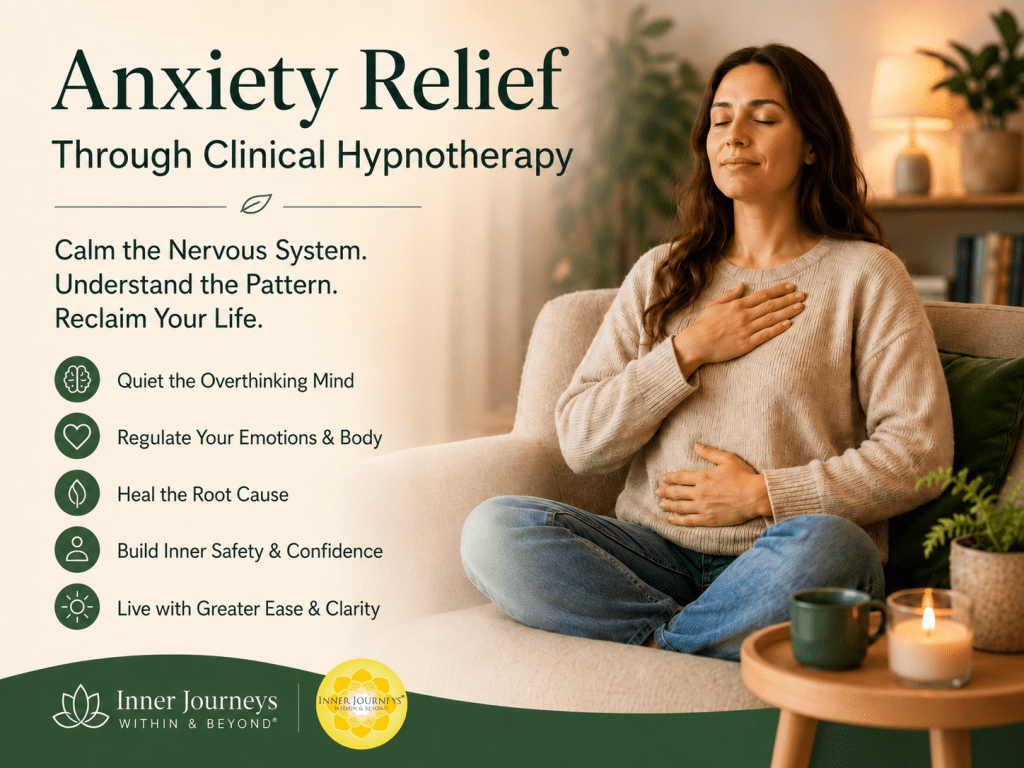
You remain aware, you can speak, and you retain control throughout the session.
Clinical Hypnotherapy may support anxiety recovery by helping you:
• reduce physical and mental hyperarousal
• access a deeper state of relaxation
• interrupt repetitive fear and worry loops
• identify subconscious beliefs associated with danger
• change catastrophic interpretations
• build internal safety and emotional stability
• strengthen confidence in handling difficult situations
• reduce sensitivity to specific triggers
• mentally rehearse calmer and more adaptive responses
• develop self-hypnosis and self-regulation skills
• process underlying emotional experiences when appropriate
Hypnotherapy does not erase every difficult thought or guarantee a life without stress.
The aim is to help you respond differently, so that anxious thoughts and sensations no longer control your decisions, relationships and daily functioning.
Evidence-Informed and Integrative
Research into hypnosis for anxiety is promising. A 2019 meta-analysis of controlled studies found that hypnosis was associated with meaningful reductions in anxiety and that outcomes were stronger when hypnosis was combined with other psychological interventions.
For this reason, we do not present hypnosis as a magical or isolated cure.
Depending upon your needs, we may integrate hypnotherapy with cognitive, behavioural, somatic, mindfulness-based and trauma-informed methods.
🧠 Explore Scientific Research in Clinical Hypnotherapy
Our Approach: Regulation Before Regression
Healing has an architecture.
When a person is already anxious or overwhelmed, immediately revisiting painful experiences can intensify distress rather than resolve it.
We therefore begin by developing safety, stability and emotional resources.
Phase 1: Understanding Your Anxiety Pattern
We explore:
• When the anxiety began
• What triggers or intensifies it
• The thoughts, sensations and behaviours involved
• Sleep, health and lifestyle factors
• Relevant emotional or traumatic experiences
• Avoidance and reassurance patterns
• The impact upon work, relationships and daily life
Where useful, structured measures such as the GAD-7 (Generalized Anxiety Disorder questionnaire) may be used to establish a baseline and monitor progress.
Phase 2: Nervous-System Regulation
Before undertaking deeper work, we help you build the capacity to return to a calmer state.
This may include:
• Hypnotic relaxation
• Diaphragmatic breathing
• Grounding and orienting
• Calming imagery
• Somatic awareness and Release
• Emotional anchoring
• Self-soothing skills
• Self-hypnosis
The aim is not merely to help you feel calm during the session, but to develop tools you can use in everyday life.
Phase 3: Changing the Anxiety Loop
Once sufficient stability has been established, we work with the thoughts, beliefs and learned responses sustaining anxiety.
This may include:
• Cognitive Behavioural Hypnotherapy
• Reframing catastrophic thinking
• Reducing anticipatory anxiety
• Hypnotic desensitisation
• Strengthening tolerance for uncertainty
• Behavioural rehearsal
• Future pacing
• Post-hypnotic suggestions
• Confidence and ego-strengthening work
Phase 4: Addressing Deeper Emotional Patterns
When anxiety is connected with childhood experiences, trauma, attachment wounds or internal conflict, deeper work may be recommended.
Depending upon your history and readiness, this may include:
• Inner Child Healing: Further on, to empower your Emotional Self, or the Inner Child from debilitating early life experiences and reprogramming deep-seated subconscious behavioral patterns, go for Inner Child Healing. Read here
• Parts Therapy: Excellent for inner conflict resolution: When you feel there are two conflicting sub personalities in you, which are fighting with each other, or sabotaging each other. Read here
• Trauma-informed Regression: Regression is not automatically used for every client. It is considered only when clinically appropriate, after adequate stabilisation, and with your informed consent. The purpose is therapeutic understanding and emotional resolution, not forcing the recovery of memories.
• Somatic Therapy: What we don’t feel or heal our body and mind reveals the pain and suffering. Listen to what the body is trying to tell you, where it needs healing, care or concern. Tapping into the Wisdom and the Healing Power of the Body. Read more:
• Integrated Eye Movement Therapy. Read more
• Memory Reconsolidation work
• Shadow Work: To understand and heal, how your dark side or our wounded side keeps running your life, and you keep repeating patterns, meeting same kind of people and situations in life. Read here
•Emotional & Mental Detox: is a wonderful, simple yet powerful method to directly access the Subconscious mind, where all our negative emotions are stored. Thus with the help of your powerful subconscious mind via hypnosis, we can release all the stress, pain, trauma, shame, and hurt, you have been storing and holding on to. Clearing out all extraneous data, files, information and memories you have been holding on to. Memories you cling to, weigh you down. Read more
Phase 5: Integration and Relapse Prevention
The final stage focuses on helping you carry the therapeutic changes into daily life.
You may work upon:
• Recognising early signs of anxiety
• Responding without panic or avoidance
• Practising self-hypnosis
• Establishing healthier boundaries
• Improving sleep and daily structure
• Reducing perfectionism and overcontrol
• Approaching previously avoided situations gradually
• Developing a more compassionate inner voice
The goal is not dependence upon the therapist.
The goal is to help you become increasingly capable of regulating yourself.
Anxiety Concerns We May Work With
Clinical Hypnotherapy may be used as part of an integrative approach for:
Generalised Worry: Persistent anxiety about work, health, finances, relationships, family or everyday responsibilities.
Panic Symptoms: Sudden waves of fear accompanied by physical sensations such as palpitations, dizziness, trembling, chest tightness or breathlessness.
Social Anxiety: Fear of being judged, embarrassed, criticised or rejected in social and professional situations.
Performance Anxiety: Anxiety related to public speaking, interviews, examinations, presentations, auditions or professional performance.
Health Anxiety: Persistent worry about illness, bodily sensations, medical reports or the possibility that something serious has been missed.
Sleep-Related Anxiety: Fear of not sleeping, racing thoughts at night, repeated checking of the time or becoming anxious about the consequences of poor sleep.
Trauma-Related Hypervigilance: Feeling constantly unsafe, watchful or easily startled following difficult or traumatic experiences.
Relationship Anxiety: Fear of abandonment, betrayal, rejection, conflict or loss within close relationships.
Phobias and Avoidance: Intense anxiety associated with situations such as flying, driving, enclosed spaces, heights, medical procedures or particular animals.
The therapeutic approach varies according to the nature, severity and origin of the concern.
What Can You Realistically Expect?
Some people seek help for one clearly defined anxiety trigger. Others have lived with chronic anxiety for years and require a longer, layered process.
Progress may include:
• Experiencing fewer or less intense anxious episodes
• Recovering more quickly after being triggered
• Sleeping more peacefully
• Feeling safer within the body
• Reducing compulsive overthinking
• Becoming less dependent upon reassurance
• Approaching situations that were previously avoided
• Responding to uncertainty with greater flexibility
• Developing greater trust in your ability to cope
The number of sessions varies according to:
• How long the anxiety has been present
• Its severity and complexity
• Whether trauma is involved
• Associated physical or psychological conditions
• Your response to the therapeutic process
• Consistency in practising the tools provided
A focused situational concern may require fewer sessions. Long-standing anxiety, panic, trauma or complex relational patterns may require a more extended therapeutic plan.
No ethical therapist can guarantee a particular result or number of sessions before understanding the individual case.
Why Choose Inner Journeys?
At Inner Journeys, anxiety is not treated as merely a collection of symptoms.
We work with the person as a whole: the conscious mind, subconscious patterns, emotional history, body responses, relationships and present circumstances.
Our approach includes:
• Trauma-informed, regulation-first care
• Clinical Hypnotherapy integrated with complementary psychological methods
• Attention to both emotional and somatic responses
• Personalised sessions rather than standardised scripts
• Practical tools for use outside therapy
• Online and in-person availability
• Clear ethical boundaries and realistic expectations
• Emphasis on self-reliance rather than therapist dependence
Sessions are facilitated by Abhishek Joshi and Priyanka Shukla, Co-Founders of Inner Journeys: Within & Beyond®.
👤 Meet Abhishek Joshi
👤 Meet Priyanka Shukla
What Happens During a Session?
A session generally includes:
- Discussion of your concern, history and present triggers.
- Identification of a clear therapeutic goal.
- Preparation and explanation of the hypnosis process.
- Regulation and resource-building.
- Hypnotic or integrative therapeutic work selected for your needs.
- Gradual reorientation and post-session discussion.
- Practical tools or exercises to use between sessions.
You will not be unconscious or asleep.
You can speak, move, ask to pause and end the process at any time.
🌿 Ready to Begin? Book a Consultation
Session duration: Approximately 60–90 minutes
Format: Online through Zoom or in person
Location: Sector 57, Gurgaon
Investment: ₹7,000 per session
Facilitators: Abhishek Joshi and Priyanka Shukla
Consultation hours: 11:00 am–7:00 pm IST
Frequently Asked Questions
Will I lose control during hypnosis?
No. Hypnosis does not remove your awareness, judgement or ability to choose. You remain an active participant throughout the process, much like a guided meditation.
What if I cannot be hypnotised?
Most people can experience hypnosis when they are willing to participate and can follow simple instructions. The depth of hypnosis varies, but therapeutic benefit does not require an extremely deep trance.
Is hypnotherapy suitable for panic attacks?
It may support panic-related concerns by addressing fear of bodily sensations, catastrophic interpretation, anticipatory anxiety and nervous-system dysregulation. New or unexplained physical symptoms should first be medically assessed.
Can hypnotherapy replace anxiety medication?
No medication should be stopped, reduced or altered without consulting the prescribing doctor. However, we have seen medication gradually reduce.
Hypnotherapy may be used alongside medical or psychological care. Coordination with your treating professional may be recommended when symptoms are moderate, severe or complex.
Will I have to revisit painful memories?
Not necessarily. Many clients benefit from regulation, cognitive reframing, desensitisation, self-hypnosis and present-focused work without regression.
Deeper memory-related work is used only when appropriate and with consent.
Can sessions be conducted online?
Yes. Clinical Hypnotherapy can be conducted online when the client has privacy, a stable internet connection and a safe environment from which to participate.
How many sessions will I need?
There is no universal number, though on an average 4-5 session, done monthly are adequate to see some results. A clearer estimate can be offered after understanding your concern, history and response to the initial work.
When Additional Medical or Psychiatric Support Is Important
Clinical Hypnotherapy is a complementary therapeutic service and is not a substitute for medical diagnosis, psychiatric treatment or emergency support.
Please seek appropriate medical or psychiatric assessment when:
• Anxiety symptoms are severe or rapidly worsening
• Panic-like symptoms are new or medically unexplained
• You are unable to manage everyday functioning
• There are thoughts of self-harm or suicide
• There is active psychosis, mania or severe substance withdrawal
• Medication needs to be reviewed
• Another medical condition may be contributing to the symptoms
Where required, hypnotherapy may be undertaken only with the knowledge or approval of the treating professional.
You Do Not Have to Keep Living in Survival Mode

Anxiety may have been trying to protect you.
But a protective response that once helped you survive can eventually begin to restrict your life.
Healing does not mean that you will never experience uncertainty, discomfort or fear again.
It means developing the inner resources to remain present, grounded and capable even when life feels uncertain.
You are not your anxiety. It is a pattern your mind and body have learned, and learned patterns can be worked with.
🌅 Take the First Step Towards Relief
💬 WhatsApp Abhishek Joshi – Enquire About Anxiety Relief
💬 WhatsApp Priyanka Shukla – Enquire About Anxiety Relief
Email: info@innerjourneys.life
All sessions are confidential. Prior appointment and payment are required. Outcomes vary according to the nature of the concern, individual responsiveness, associated conditions and participation in the therapeutic process.
Already taking the next step? The following practices can help you support your progress between sessions and strengthen long-term recovery.
Further Support: Practices for Long-Term Anxiety Recovery
A therapeutic session can initiate change, but lasting recovery is strengthened by what you practise and reinforce in everyday life.
The aim is not to monitor yourself constantly or perform every practice perfectly. It is to help your mind and nervous system experience safety, steadiness and self-trust more consistently.
After Your Session: Integration and Practice
After a hypnotherapy session:
• keep the remainder of your day reasonably unhurried, where possible
• allow significant insights to settle before analysing them excessively
• note any important thoughts, emotions, bodily responses or dreams that arise
• practise the grounding, breathing or self-hypnosis exercise recommended during your session
• maintain regular meals, hydration and sleep
• give emotionally significant insights time before making major decisions
• communicate relevant changes or concerns during your next session
You may notice changes immediately, gradually or only when you encounter a familiar trigger and realise that you are responding differently.
Healing is not always dramatic. Sometimes it appears as a quieter mind, a shorter anxious episode, a healthier boundary, a better night’s sleep or an increased ability to remain present during discomfort.
If you experience unexpected or persistent distress after a session, please contact your facilitator or an appropriate mental-health professional.
Daily Practices That Support Long-Term Anxiety Recovery
1. Create a More Sustainable Pace
A life organised around urgency can repeatedly signal danger to the nervous system.
Try to:
• reduce unnecessary multitasking
• give yourself realistic time for important tasks
• include small buffers between commitments
• break large responsibilities into manageable steps
• take brief pauses during the working day
• question the belief that everything must be completed immediately
Slowing down does not necessarily mean becoming less productive. It means reducing the internal pressure that keeps the mind and body in a constant state of alarm.
2. Regulate the Body Regularly
Do not wait until anxiety becomes overwhelming before using your regulation tools.
Practise one or more of the following each day:
• slow and comfortable breathing
• grounding through the senses
• a brief body scan
• self-hypnosis
• calming imagery
• gentle stretching
• walking, yoga or another form of enjoyable movement
• brief pauses of thirty seconds to two minutes between demanding tasks
Regular practice makes these resources easier to access when you genuinely need them.
3. Support Sleep, Nutrition and Physical Wellbeing
An anxious mind becomes more difficult to regulate when the body is exhausted, overstimulated or undernourished.
Pay attention to:
• maintaining a reasonably consistent sleep routine
• eating regular and balanced meals
• remaining adequately hydrated
• observing whether caffeine, alcohol or excessive sugar aggravates your symptoms
• including regular physical movement in a form you can sustain
• seeking medical assessment for unexplained or persistent physical symptoms
Healthy habits can support anxiety recovery, but they are not substitutes for appropriate psychological or medical treatment.
4. Change Your Relationship With Anxious Thoughts
Trying to forcibly suppress a thought often gives it more importance.
Instead, pause and ask:
• Is this a fact, a possibility or a fear?
• Is there something practical I can do at this moment?
• Am I solving a problem or repeatedly rehearsing it?
• What is within my control today?
• What is the next manageable step?
You do not have to believe every thought merely because it appears in your mind.
Notice it, name it and gently return your attention to the present task.
5. Distinguish Intuition From Anxiety
Anxiety often feels urgent, repetitive and catastrophic. It demands certainty and may imagine numerous threatening possibilities.
Intuition is usually quieter, clearer and more specific.
Rather than automatically obeying every fearful feeling, regulate yourself first. Revisit the situation when you are calmer and then consider what the feeling may be communicating.
A genuine concern can still be addressed without allowing fear to take complete control.
6. Reduce Perfectionism and Overcontrol
Perfectionism often promises safety but creates continuous internal pressure.
Practise allowing:
• a task to be completed adequately rather than flawlessly
• other people to do things differently from you
• plans to change without assuming that everything will collapse
• uncertainty to exist without immediately trying to eliminate it
• mistakes to become information rather than evidence of failure
You do not need complete control in order to remain capable.
7. Use the HALT Check-In
When anxiety or emotional reactivity increases, pause and ask whether you are:
H — Hungry
A — Angry
L — Lonely
T — Tired
These states do not explain every anxious episode, but they can reduce your capacity to cope.
Respond to the immediate need where possible: eat, rest, speak with someone trustworthy, take space, regulate your breathing or seek appropriate support.
8. Seek Support Without Creating Dependence
You do not have to manage everything alone.
Speak with a trusted friend, family member, therapist, mentor or healthcare professional when you need support.
At the same time, notice repeated reassurance-seeking. Reassurance may bring temporary relief while unintentionally teaching the mind that you cannot tolerate uncertainty without someone else confirming that you are safe.
The aim is to receive support while gradually strengthening your own capacity to regulate and decide.
9. Choose Regulation Before Reaction
When emotionally activated, pause before replying, confronting someone or making an important decision.
Choosing peace does not mean suppressing legitimate anger, tolerating mistreatment or abandoning your boundaries.
It means regulating yourself sufficiently so that you can respond with clarity rather than react from fear, irritation or overwhelm.
10. Draw Upon Spiritual Resources
For those who find strength in faith, prayer, surrender and remembrance of a Higher Power can provide comfort and perspective.
The Serenity Prayer may be especially meaningful:
Grant me the serenity to accept the things I cannot change,
the courage to change the things I can,
and the wisdom to know the difference.
Spiritual surrender does not mean passivity. It means taking responsible action where you can, while gradually releasing the demand to control everything that you cannot.
11. Expect Progress, Not Perfection
Recovery is rarely a perfectly straight line.
A difficult day or the temporary return of an old response does not mean that your progress has disappeared.
Instead of asking, “Why am I anxious again?”, consider asking:
• Did I recognise the anxiety earlier?
• Was the intensity different?
• Did I recover more quickly?
• Did I use a healthier response?
• What does this experience teach me about what I still need?
Progress is often measured not by never feeling anxious, but by becoming less controlled by anxiety when it appears.
“Maybe if you carried bad memories around long enough,
they started to change how you walked, how you talked. How you thought.”
― Julia Keller


