Most people begin their spiritual journey looking for peace.
Some are seeking healing from emotional pain. Some are searching for meaning, clarity, or a deeper connection with themselves and the Divine. And yet, despite all our inner work and spiritual practices, there is one place where growth is most often tested — relationships. In ordinary moments of everyday life: misunderstandings with family, disappointments with friends, tension with colleagues, disagreements with a spouse, or the quiet pain of feeling criticised, misunderstood, rejected, or unseen.
It is often here, in the messiness of human relationships, that spiritual growth becomes real.
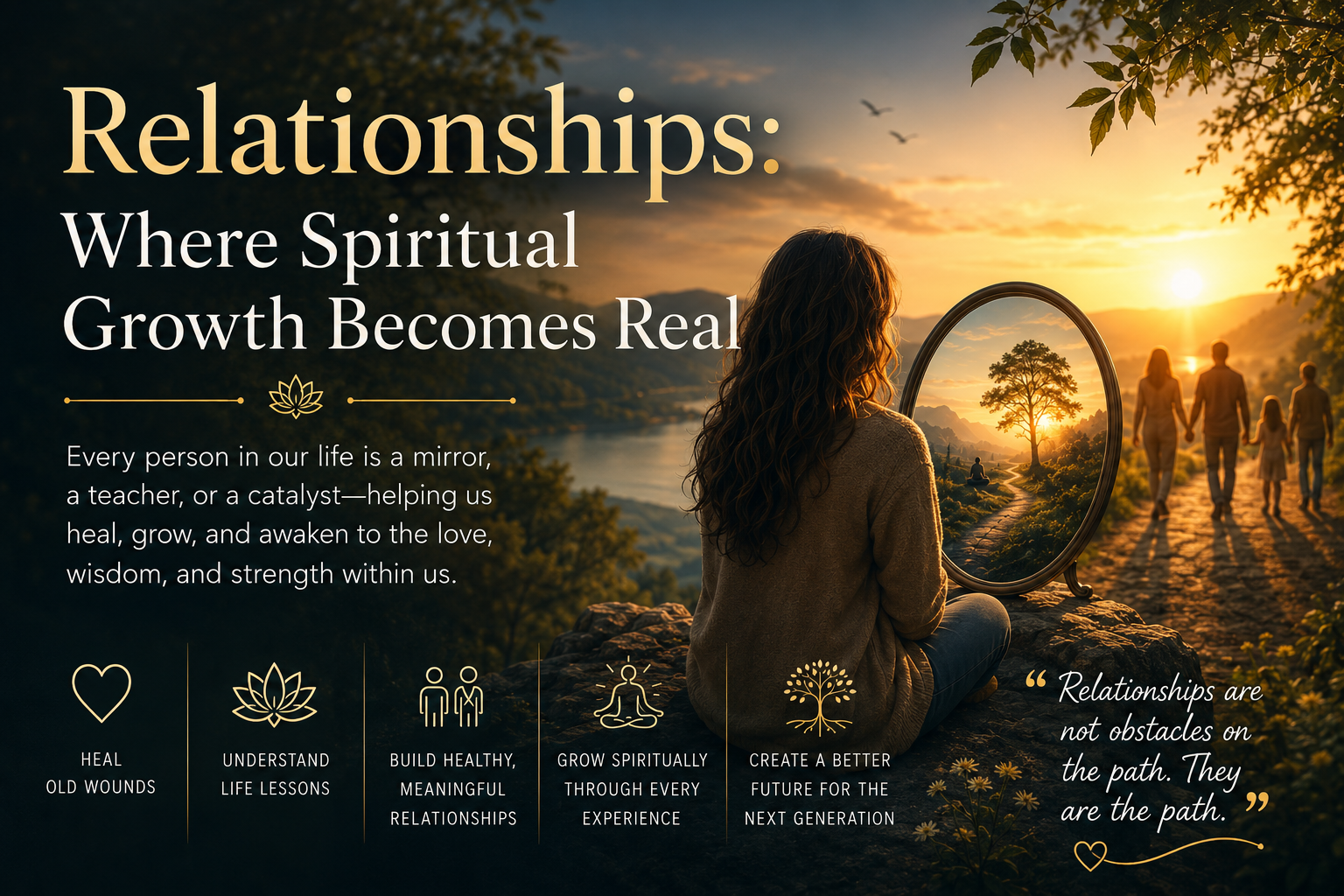
Because relationships have a way of revealing parts of ourselves we may not fully recognise otherwise. They bring to the surface our fears, insecurities, emotional wounds, unmet needs, expectations, attachment patterns, and limiting beliefs. In many ways, relationships become mirrors. Not always comfortable mirrors, but deeply truthful ones.
And perhaps that is why relationships become one of the greatest tools for inner growth.
Not because they are always easy. Not because they are always peaceful. But because they invite us to become more aware, more compassionate, more emotionally mature, and, ultimately, more conscious in how we live and relate to others.
Relationships Reveal What Still Needs Healing
One of the greatest misconceptions people carry is the belief that if they are spiritual or doing inner work, they should stop getting emotionally triggered. But emotional triggers are not signs of failure. Very often, they are signs of unfinished healing.
When someone criticises us, ignores us, excludes us, misunderstands us, behaves harshly, or repeatedly disappoints us, something deeper within may get activated. We may suddenly feel rejected, ashamed, anxious, angry, helpless, unseen, abandoned, or emotionally unsafe.
Sometimes the intensity of our emotional reaction surprises even us.
Why did this affect me so deeply? That question can become the beginning of powerful self-awareness.
Because strong emotional reactions often point toward deeper beliefs and emotional wounds that still need healing. Some of the most common beliefs many people unconsciously carry are:
“No one likes me.”
“I am not good enough.”
“I am not lovable.”
“I am not worthy of love.”
These beliefs rarely exist in isolation. They tend to travel together and quietly influence how we experience ourselves and our relationships.
Someone who unconsciously believes they are not lovable may constantly seek reassurance or become overly sensitive to rejection. Someone who feels they are not good enough may struggle deeply with criticism, perfectionism, comparison, or people-pleasing. A person carrying old abandonment wounds may begin interpreting neutral situations as signs that people dislike or leave them.
Over time, these beliefs begin shaping relationships in subtle but powerful ways. They influence what we tolerate, what we fear, how we react, what we expect, and even the kinds of people we are repeatedly drawn toward.
This is often why relationship patterns repeat. Different faces. Different situations. Yet strangely familiar emotional pain. Sometimes life is simply bringing us another opportunity to become aware of something unresolved. Because some deeper beliefs may still need awareness, healing, and conscious work, they do not keep repeating through different relationships.
Rather than only asking:
“Why is this happening to me?”
We slowly begin asking something far more empowering:
“What inside me is asking to be healed?”
That shift alone can begin transforming relationships into pathways for growth.
Emotional Triggers Are Teachers
Most of us naturally focus on what others are doing wrong. “He is insensitive.” “She never understands me.” “My family is impossible.” “People always disappoint me.” And to be fair, sometimes people genuinely behave poorly.
But growth often begins when we become willing to ask a second question alongside the first. Not only “Why are they behaving this way?” but also “Why does this affect me so deeply?” This is not about blaming ourselves or excusing unhealthy behaviour. It is about becoming curious. Because emotional intensity is often the clue.
Sometimes criticism hurts deeply because somewhere inside, we already fear we are not enough. Sometimes conflict feels unbearable because emotional instability was familiar during childhood. Sometimes we become excessive people-pleasers because love once felt conditional. Sometimes rejection feels devastating because an old abandonment wound still exists beneath the surface.
Seen in this way, emotional triggers stop becoming enemies. They become teachers. They gently reveal where healing is still needed. And when approached consciously, relationships stop becoming battlegrounds and begin becoming classrooms for emotional and spiritual growth.
The truth is, we often grow the most — and the fastest — through our handling of relationship challenges. Not by seeking perfect relationships, but by learning how to relate to one another at a deeply human level.
Beneath our personalities, fears, emotional struggles, and differences, there is something profoundly universal: we are all seeking love, peace, affection, understanding, and belonging. And often, by becoming more capable of offering these qualities, we slowly become more capable of receiving them too.
The People in Our Lives Are Not Always Accidental
One of the deeper understandings that emerges through Spiritual Regression and Life Between Lives work is this: many of the important people in our lives are not random.
This includes not only partners, but also parents, siblings, relatives, children, colleagues, and even certain difficult people who profoundly impact us.
Sometimes, before birth, souls choose certain themes and experiences for growth. Certain relationships may become part of a broader soul curriculum designed to help us develop particular qualities, heal unresolved wounds, or learn important life lessons.
This does not mean life becomes fixed or fatalistic. Nor does it mean suffering must simply be endured.
Rather, it invites us to consider a deeper possibility:
What if some relationships entered our lives because they were meant to help us grow?
One person may help us learn patience. Another may challenge us to develop boundaries. Someone may teach us courage. Another may bring us face to face with self-worth. And sometimes, difficult people reveal our deepest wounds so healing can finally begin. This is why running away, blaming, avoiding, or denying may not always help us grow.
Growth begins when we start seeing ourselves as students of life. When we become willing to ask:
“What is this relationship trying to teach me?”
“What wound in me is asking for healing?”
“What part of me is trying to grow?”
That shift changes everything. Relationships stop feeling like punishments. And begin to become opportunities for evolution.
Spiritual Growth Is Reflected in Relationships
Many people think spiritual growth means meditation, intuition, spiritual knowledge, or feeling peaceful. But perhaps there is another question worth asking:
How do we behave in relationships?
Are we becoming kinder? More emotionally stable?
Less reactive? Better listeners?
More compassionate? More emotionally responsible?
Because the quality of our relationships often reflects the quality of our inner growth.
If spirituality only exists in meditation but disappears in difficult conversations, emotional conflicts, or everyday relationships, then something important is still waiting to be integrated. Relationships often become one of the clearest measures of spiritual maturity. Not perfection, but progress.
Growth is reflected in small but meaningful shifts. Can we pause before reacting? Can we communicate with warmth even during difficult moments? Can we disagree respectfully? Can we hold boundaries without aggression, or continue seeing another person’s humanity even when we feel hurt?
These are not small achievements. They reflect emotional maturity, self-awareness, and conscious effort. This is where spirituality slowly becomes a lived experience rather than only an idea. This is where spiritual growth becomes real.
Emotional Maturity Is a Skill We Learn
Managing relationships is a skill. Healthy relationships do not happen automatically, nor are we born knowing how to navigate emotional challenges gracefully.
Most people were never taught emotional regulation. Many grew up witnessing criticism, emotional volatility, emotional shutdown, avoidance, passive aggression, or unresolved conflict. Naturally, we tend to repeat what we saw. Not because we are flawed. But because behaviour is learned. And yet emotional maturity can be developed.
We can learn emotional regulation. We can become more emotionally stable. We can communicate more consciously and learn to respond instead of react.
This is not about becoming emotionally perfect. It is about becoming more aware. Pausing before reacting. Communicating with more kindness.Taking responsibility for our emotional triggers. Learning how to disagree without disrespect. And perhaps this is one of the greatest gifts we can offer the next generation.
Because beliefs are not only transferred through words. They are transferred through behaviour. Not only through how we behave with our children, but also through the relationships they witness around us. What beliefs we exemplify often becomes what they learn — far more than what we say.
This makes self-examination deeply valuable. A worthwhile question to ask ourselves becomes:
“Am I setting an example of warm, cordial, compassionate relationships?”
Or are children mostly witnessing criticism, emotional distance, resentment, conflict, or apathy?
Healing ourselves may be one of the greatest gifts we can offer the next generation.
Emotional Karma and Human Connection
One of the biggest shifts that begins happening in relationships is when we stop seeking perfection and begin relating to one another at a deeply human level.
The truth is, all of us are carrying something. Some carry pain, disappointment, loneliness, or rejection. Others quietly carry fears of abandonment, inadequacy, or not feeling loved enough. Beneath outward behaviour, many people are simply longing to feel emotionally safe, respected, accepted, and understood.
When we begin recognising this shared human experience, something softens within us. We become less judgmental, less reactive, and less invested in being right all the time. Compassion slowly begins replacing harshness.
Because beneath our personalities, behaviours, emotional defences, and struggles, there is something deeply universal: we are all seeking love, peace, affection, understanding, and belonging.
This does not mean tolerating unhealthy behaviour or abandoning boundaries. It simply means learning to see one another through more human eyes.
When we begin relating from this place, relationships slowly start changing. Warmth tends to invite warmth. Respect often deepens respect. Compassion creates more compassion, and emotional safety encourages openness.
In many ways, this becomes emotional karma. What we repeatedly give out emotionally often finds its way back to us in one form or another — not always immediately, and not always from the same people. But over time, the emotional energy we cultivate begins shaping the quality of our relationships.
Perhaps one of the simplest yet deepest shifts we can make is learning to like people a little more — not because they are perfect, but despite their imperfections, much like we quietly hope others may learn to accept ours.
The more we grow emotionally, the less we expect perfection from relationships and the more we begin appreciating human connection for what it truly is: imperfect, sometimes messy, yet deeply meaningful.
A Simple Exercise for Self-Reflection
The best way to begin identifying limiting beliefs is through honest self-examination.
Most people are unaware of the beliefs quietly operating beneath the surface until life begins revealing them through emotional pain, conflict, repeated disappointments, or recurring relationship patterns. This is where self-reflection becomes a powerful starting point. Begin by noticing recurring emotional triggers.
Ask yourself:
• What irritates me the most in others?
• What situations upset me disproportionately?
• What criticism hurts me the most?
• What situations make me feel anxious, ashamed, angry, rejected, helpless, or emotionally unsafe?
• What relationship patterns keep repeating in my life?
The emotional intensity is often the clue. Very often, our strongest reactions point toward deeper fears, beliefs, wounds, or unmet emotional needs.
Patterns reveal beliefs. And awareness becomes the beginning of healing. Sometimes simply becoming conscious of our emotional patterns can begin changing the way we relate to others.
An Important Clarification: Spiritual Growth Does Not Mean Enduring Abuse
At this point, an important clarification becomes necessary. Using relationships as tools for growth does not mean enduring abusive, manipulative, traumatic, or deeply unhealthy relationships indefinitely. Over the years, many people have been told:
“This is your karma. Stay and suffer. Let the karma exhaust itself.”
While this may sound spiritual on the surface, it can sometimes become a passive and fatalistic way of viewing relationships.
Growth does not happen through helpless suffering alone. Spirituality is not about becoming smaller, silencing yourself, abandoning your truth, suppressing your needs, or endlessly tolerating pain in the name of karma. Real spiritual growth also includes becoming stronger.
More empowered. More self-aware. More courageous.
Sometimes growth means learning boundaries. At other times, it means finding your voice, standing in your light, and developing the courage to stop abandoning yourself. And sometimes, the lesson itself may include leaving a toxic or abusive relationship in an empowered and conscious way, even when that difficult relationship involves parents, family, or people we deeply care about.
Sometimes the soul lesson is not staying. Sometimes it is learning self-respect, courage, discernment, or emotional independence. The deeper question is not, “How long must I tolerate this?” but rather, “What is life trying to help me learn through this experience?” That shift changes everything. Because spiritual growth is not passive. It is deeply empowering.
Every Soul’s Journey Is Different
Every life script is different. And so are life lessons. What may be growth for one person may become avoidance for another. What may be patience for one person may become self-abandonment for someone else. From the lens of Spiritual Regression, relationships are not random interruptions in our lives but often meaningful soul encounters — some gentle, some difficult, some deeply transformative.
This is precisely why one-size-fits-all spiritual advice often falls short. When relationships become difficult, everybody offers advice through the lens of their own experiences, wounds, beliefs, and conditioning. Some may say leave. Others may say stay, forgive, detach, or tolerate. But what is right for one person may not necessarily be right for another. Without understanding our own life lessons, it becomes easy to rely on generalities or spiritual aphorisms that may not truly apply to our journey.
Much like internet algorithms, we can unknowingly fall into confirmation bias — collecting opinions that reinforce what we already feel. But genuine growth asks something deeper. It asks us to know ourselves. To understand what exactly we are here to learn. This is where spiritual guidance becomes valuable.
Through Spiritual Regression, mentoring, meditation, deeper inner work, and developing a connection with our inner wisdom, Spirit Guides, or Guardian Angels, we slowly begin receiving a more neutral and soul-aligned perspective.
A perspective that sees beyond emotional overwhelm.
A perspective that understands our soul’s journey across lifetimes.
A perspective that gently asks:
“What exactly am I here to learn?”
“What is this relationship trying to teach me?”
“What am I trying to heal?”
“What part of me is trying to grow?”
Because ultimately, the journey is not only about fixing relationships. It is about knowing yourself. And when we begin knowing ourselves more deeply, relationships begin changing too.
Turning Relationships into a Path of Healing
At Inner Journeys, some of the deepest healing tools we work with — Inner Child Healing, Shadow Work, Spiritual Regression, and Life Between Lives work — often help people understand recurring relationship patterns at a much deeper level.
Sometimes the wounds we carry began in childhood. Sometimes we repeat unconscious emotional patterns. Sometimes unresolved fears, abandonment wounds, rejection, shame, or old emotional conditioning quietly shape the way we relate to others.
And sometimes, relationship struggles reveal deeper soul lessons that become visible only through deeper inner exploration. Through regular mentoring, we help seekers understand emotional triggers, recurring patterns, difficult relationship dynamics, and the deeper opportunities for healing hidden within life’s challenges.
Relationships slowly become less about blame and more about awareness. Less about helplessness and more about empowerment. Less about suffering and more about growth. Because perhaps relationships were never meant to break us. They were meant to awaken us.
And if we are willing to remain students of life, relationships can slowly become one of our greatest teachers.
Not perfect.
Not always easy.
But deeply transformative.
Struggling with Relationship Challenges? Turn Them into a Path for Healing and Growth
If you find yourself repeatedly struggling with difficult relationships, emotional triggers, recurring patterns, feelings of rejection, loneliness, people-pleasing, conflict, or emotional overwhelm — know that these experiences are not necessarily signs that something is wrong with you.
Sometimes, relationships show us what still needs healing. Sometimes, they are revealing emotional wounds, childhood conditioning, shadow aspects, unresolved fears, or deeper soul lessons waiting to be understood. And sometimes, what feels like emotional pain can quietly become an invitation toward profound inner growth.
At Inner Journeys, we help seekers understand relationship patterns at a deeper level through a combination of:
- Inner Child Healing
- Shadow Work
- Clinical Hypnotherapy
- Spiritual Regression & Life Between Lives (LBL)
- Emotional Healing & Mentorship
- Spiritual Guidance
Through regular mentoring, we help seekers make sense of recurring relationship struggles, emotional triggers, and deeper life patterns so that relationships gradually become pathways for healing, emotional maturity, and conscious growth.
Because healing relationships begin with understanding yourself.
And when inner change begins, outer relationships often begin changing too.
Ready to Begin Your Journey?
If you would like guidance in understanding your relationship challenges more deeply and transforming them into opportunities for healing and growth, we invite you to connect with us.
🔹 Meet Your Facilitators
Abhishek Joshi: +91 9810 206293. View Profile →
Priyanka Shukla: +91 9594 280000. View Profile →
📧 Email: innerjourneys11@gmail.com / info@innerjourneys.life
We offer in-person sessions in Gurgaon, Mumbai and Bhopal and online sessions worldwide.
To begin:
Please send your name, a recent photo, and a short description of your issue.
We always seek permission from Spirit Guides before we begin.
Additional Resources:
- Inner Journeys Healing Roadmap
- The Missing link in Healing
- Understanding Karma
- Understanding Inner Child Healing
- Understanding Trauma
- Emotional Root of Diseases
- Practical Spirituality


